Sample Assessment
On this page we show you excerpts from our sample report. You'll see the scores achieved per module, an AI readiness rating, prioritized findings, and quick wins. In an assessment we surface all of it from more than 200 deterministic checks. The values on this page are sample data and illustrate how we present the results.
Report Preview
Your full report has three parts: an executive summary for the overview, an architect deep-dive for the technical detail, and a developer punch list for the work itself.
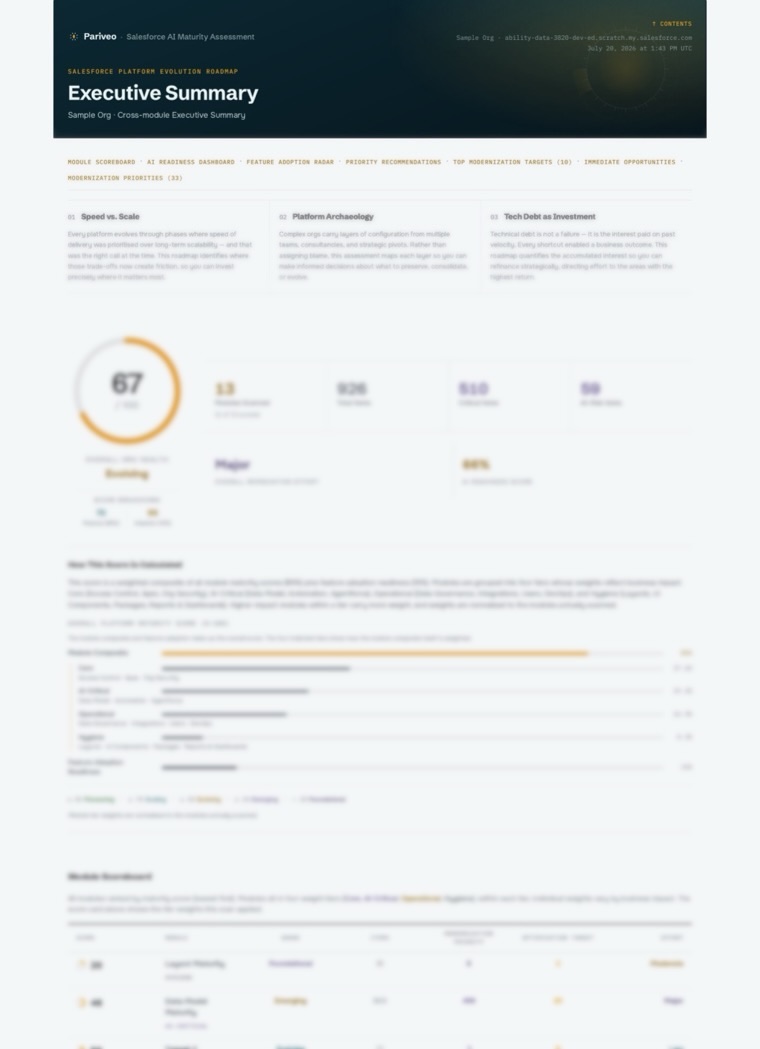
Actual pages from a sample assessment
Module Scoreboard
Every one of the 15 analysis modules gets its own maturity score. We sort the list by improvement potential, so the areas with the most room to grow sit right at the top.
Agentforce
58Automation
64Reports & Dashboards
64DevOps
69Apex Health
71UI Components
72Object Maturity
73Integrations
77Layouts
81Data Model
82Packages
85Access Control
88Org Security
90Data Governance
91User Health
93AI Readiness
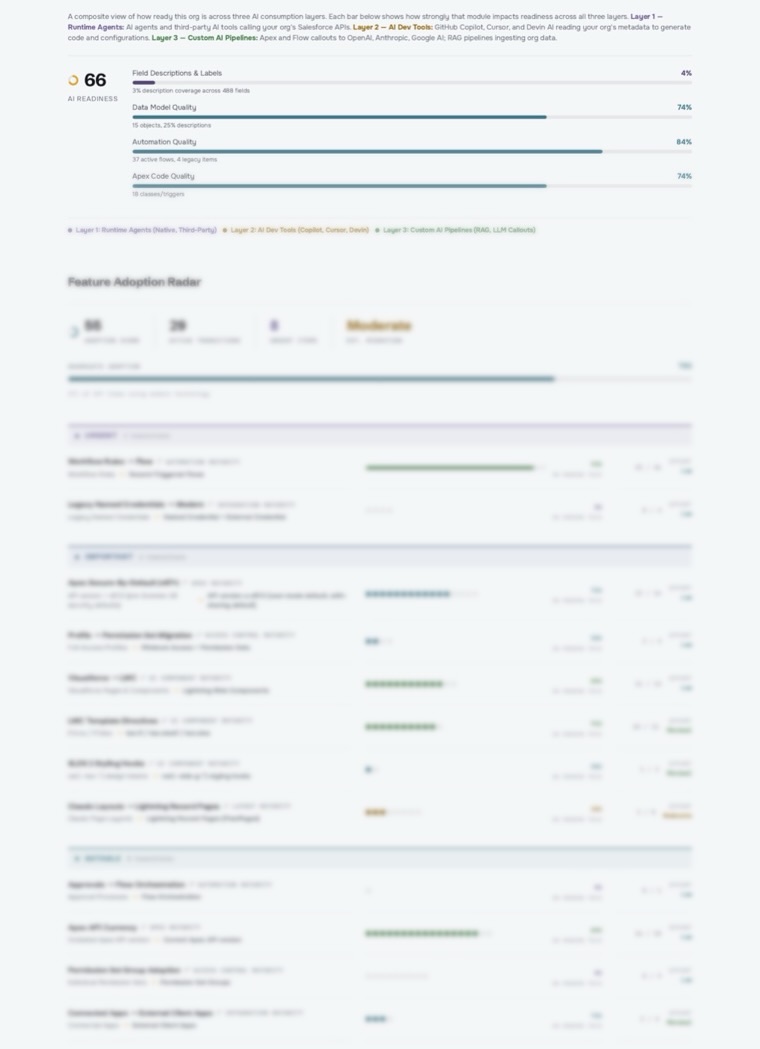
The following five dimensions show how well your org supports AI agents, AI coding agents, and LLM grounding. After all, descriptions, labels, and data-model and code quality form the working context AI coding agents work with.
Feature Adoption
Of the 30+ adoption transitions we track, here are eight. They show how far your org has moved from legacy patterns to modern Salesforce standards, ranked by what Salesforce itself recommends.
697 / 846 adopted
Workflow Rules → Record-Triggered Flows
Workflow Rules→Record-Triggered Flows
312/ 359 adoptedM
Process Builder → Record-Triggered Flows
Process Builder→Record-Triggered Flows
58/ 81 adoptedL
Profiles → Permission Set Groups
Profiles→Permission Set Groups
39/ 47 adoptedL
Visualforce → Lightning Web Components
Visualforce→Lightning Web Components
89/ 123 adoptedXL
Aura Components → Lightning Web Components
Aura Components→Lightning Web Components
67/ 81 adoptedL
Page Layouts → Lightning Record Pages
Page Layouts→Lightning Record Pages
83/ 89 adoptedS
Legacy Named Credentials → Named Credentials + External Credential
Legacy Named Credentials→Named Credentials + External Credential
18/ 23 adoptedM
Change Sets → Metadata API / SF CLI
Change Sets→Metadata API / SF CLI
31/ 43 adoptedL
Priority Findings
Here are four selected findings from this org. They're just a small slice of what your full assessment will surface.
209 Objects With Unrestricted Public Read/Write Sharing
UrgentOrganization-Wide Defaults leave 209 objects fully open to all internal users, including AI agents operating on their behalf. Tightening sharing rules would reduce the AI data surface area by an estimated 60%.
Sensitive Fields Editable Without a Field-Level Security Review Cycle
Important19 permission sets grant edit access to fields matching PII patterns (national ID, payment reference, contract value), with no automated cycle to detect permission drift as teams evolve.
8 Named Credentials on Legacy Embedded-Credential Architecture
Important8 integration connections use the pre-API v55 model with static embedded credentials. This pattern is incompatible with per-user OAuth token contexts required by AI agent callouts and Flow-based external service invocations.
Automation Hotspot: Account Has 14 Active Record-Triggered Flows
NotableAccount accumulates 14 record-triggered flows from 6 different teams, including 3 before-save flows sharing the same entry point without entry conditions. This creates unpredictable execution order and complex debug paths.
Quick Wins
These changes take little effort but noticeably raise your org's maturity. They make good first steps when you want quick, visible progress.
Add Descriptions to Core Fields
Fill 340 empty descriptions on high-traffic custom fields to boost AI readability by +12 pts.
Deactivate Legacy Workflow Rules
Safely deactivate 47 migrated workflow rules still running in parallel with replacement Flows.
Consolidate Redundant Permission Sets
Merge 6 near-identical permission sets into 2 consolidated groups, reducing admin overhead.
High-Impact Objects
These objects carry the largest combined potential across several dimensions, from field quality and automation to permission scope. They point you to where modernisation pays off the most.
| Object | Maturity Score | Fields | Flows | Top Findings |
|---|---|---|---|---|
| Case | 38 | 142 | 27 | 12 |
| Opportunity | 44 | 98 | 19 | 8 |
| Commission_Payment__c | 51 | 76 | 14 | 6 |
| Subscription__c | 57 | 63 | 11 | 5 |
| Invoice__c | 62 | 45 | 8 | 3 |
Want this for your org?
Book a free 30-minute discovery call. In it, we identify which points matter most to you and focus the assessment accordingly. You then receive your executive report within 5 to 10 business days after access is granted.
Book a Discovery Call